.avif)
For many patients, surviving sepsis is only the beginning of their recovery journey.
Even after the life-threatening infection has been treated, many survivors experience lasting immune dysfunction that leaves them vulnerable to future infections and other complications.
East Tennessee State University’s Dr. Kun Yang has received a $3.1 million grant from the National Institutes of Health’s (NIH) National Institute of Allergy and Infectious Diseases to investigate why, and lay the groundwork for potential new approaches to treatment.
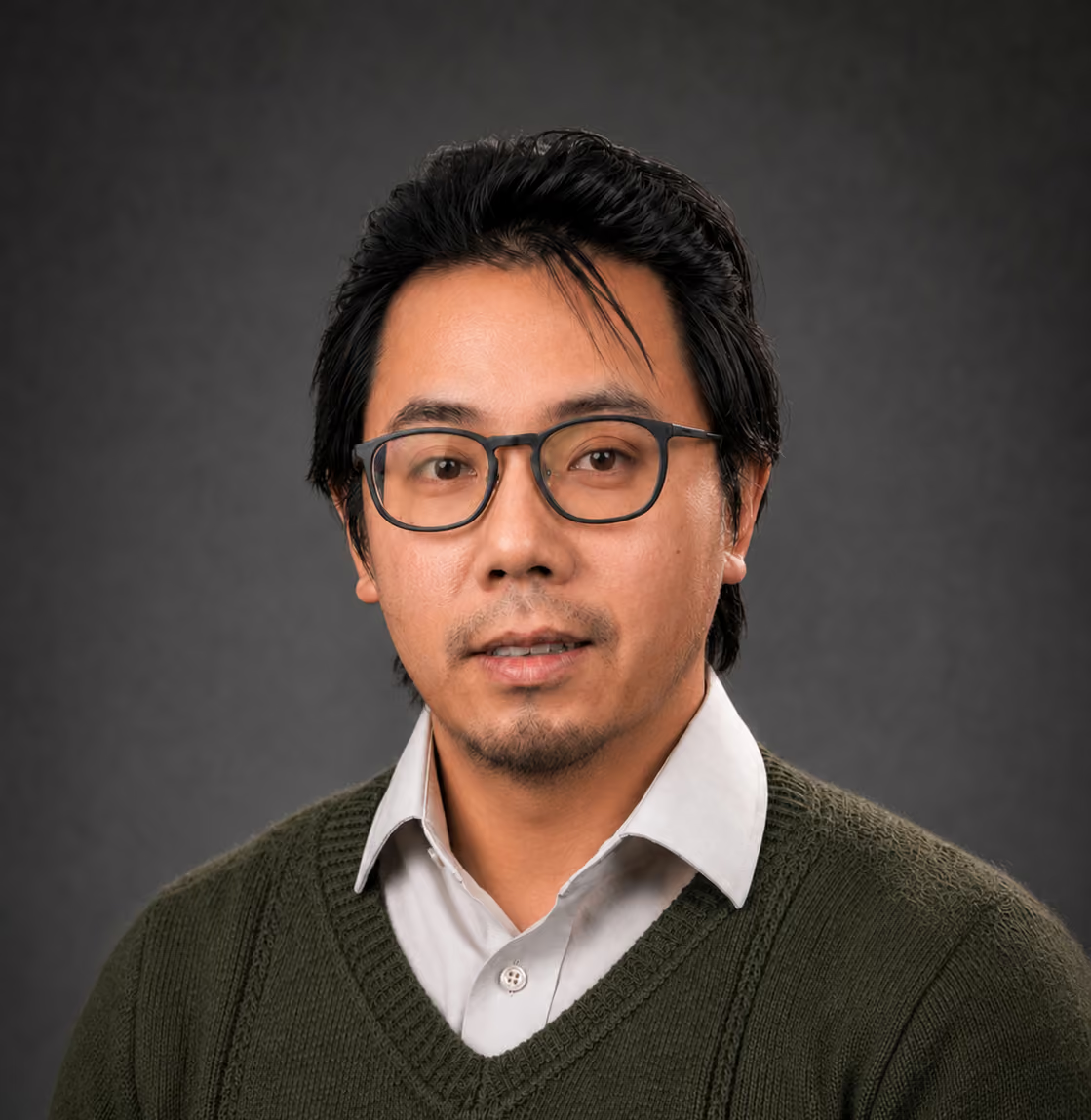
Yang’s grant proposal, “Elucidating the Role of Lactate in Immune Dysfunction During Sepsis: A Focus on B Cell Modulation,” received a first-percentile score in peer review at the NIH, placing it among the top 1% of proposals evaluated.
“Sepsis affects about 1.7 million U.S. adults each year, and one in three adults who die in a hospital had sepsis during that hospitalization,” said Yang, an assistant professor in the Quillen College of Medicine’s Department of Biomedical Sciences. “Although some patients survive the initial crisis, many experience prolonged immune suppression that leaves them vulnerable to secondary infections, slower recovery and other long-term complications. Our research seeks to understand why normal immune function is not fully restored and how we might help patients recover more completely.”
Clinicians and scientists have long viewed elevated lactate – a natural byproduct of metabolism – as a marker of how severely ill a patient is. But preliminary research at ETSU suggests lactate may play a much larger role.
Yang’s group has been among the early teams studying lactylation, a process in which lactate adds small chemical marks to proteins and can change how cells function. Scientists increasingly see lactylation as an important link between metabolism and cell behavior, with the potential to reveal how diseases such as sepsis reshape the immune system.
Instead of simply signaling disease severity, pathological levels of lactate may actively interfere with the body's immune response by altering B cell function, which are the immune cells responsible for producing antibodies and providing long-term protection against infection. Yang seeks to understand how pathological levels of lactate alter B cell function and whether mechanisms such as protein lactylation help drive these changes.
“Because B cells are essential for antibody production, immune memory and long-term protection against infection, this finding suggests that elevated lactate may actively contribute to the prolonged immune suppression experienced by sepsis survivors,” said Yang. “This may help explain why some sepsis survivors remain vulnerable to infections long after the initial crisis has passed.”
Yang's work builds on a growing portfolio of sepsis research at ETSU, where investigators are exploring new ways to understand, prevent and treat one of the nation's most complex medical conditions.
“Dr. Yang, who recently joined our department, has further strengthened our department’s research mission through this new NIH-funded project,” said Dr. Krishna Singh, chair of Quillen’s Department of Biomedical Sciences. “This award underscores the excellence of research within the department and reflects our commitment to advancing scientific discovery and improving public health.
“NIH support not only validates the importance of this work, but also helps drive future innovation and collaboration,” Singh added.
In recent years, researchers at the Quillen College of Medicine have secured more than $8 million in NIH funding to investigate the biological mechanisms that drive sepsis and identify new therapeutic targets.
"Research like Dr. Yang's demonstrates the strength of our scientific enterprise and our commitment to tackling some of the most pressing health challenges facing patients," said Dr. Bill Block, ETSU’s vice president for Clinical Affairs and dean of the Quillen College of Medicine. "By investing in innovative research and supporting our faculty, ETSU is helping advance discoveries that have the potential to improve care not only for the people of Appalachia, but for patients around the world."
According to the U.S. Centers for Disease Control and Prevention, sepsis sickens more than 1.7 million Americans each year and is a leading cause of mortality in hospitals. Sepsis occurs when the body responds improperly to an infection and triggers a chain reaction in the body, causing tissue damage, organ failure and death.
“Although this study is an early step rather than a direct path to a treatment, it could provide the scientific foundation for future strategies to restore immune protection and improve long-term outcomes for sepsis survivors,” Yang said.
As Tennessee's largest public academic health sciences center and the flagship institution of Appalachia, ETSU is committed to advancing research that improves lives. From groundbreaking discoveries in sepsis and infectious disease to innovations in cancer, rural health and population health, ETSU researchers are addressing some of the most pressing health challenges facing the region and beyond while preparing the next generation of scientists and healthcare professionals.
Learn more about ETSU’s commitment to research that makes a difference in Appalachia and beyond at etsu.edu/trailblazers/.
.jpg)
.jpg)