

A fossil unearthed more than three decades ago is helping rewrite the history of one of the North Pacific’s most unusual marine mammals.
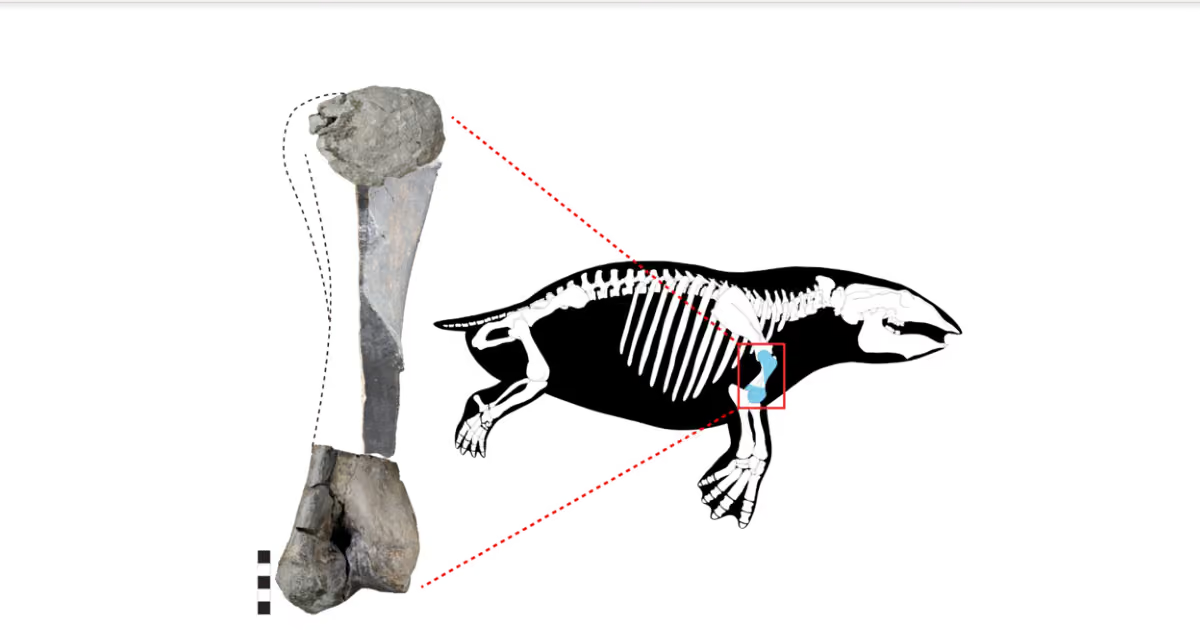
East Tennessee State University’s Dr. Kumiko Matsui led a research team that reexamined an arm bone fossil discovered during road construction in northern Japan, identifying it as a juvenile Desmostylus – an extinct, elephant-sized marine mammal unlike any living species.
Their findings provide new insight into how the ancient herbivore grew, spread and ultimately disappeared millions of years ago. Matsui and her collaborators, former graduate student Marin Mitoh and professor Takehisa Tsubamoto of Ehime University in Japan, published their findings in the journal Scientific Reports.
Interestingly, the breakthrough came not from the fossil itself, but from decades-old archival records.
While visiting Obira Town – located on the northwest coast of Hokkaido, Japan – in 2024, Matsui uncovered excavation documents, photographs and locality records preserved by the Obira Cultural Exchange Center.
Matsui first visited Obira Town in 2014 seeking more information about the specimen’s fossil record. It took a decade before she found what she was looking for.
“The area around Obira Town is famous for ammonite fossils, and it was on the way back from ammonite hunting. But at that time, I could only see some old photos, copies of books on desmostylia, and a replica of a Desmostylus humerus,” Matsui said of her trip there in 2014. Recalling my experience 10 years ago, I decided to visit Obira Town again, and, very fortunately, I was able to obtain some important records.”
Though previously believed to be the fossil of a primitive desmostylian, perhaps Behemotops – another extinct aquatic animal similar to a modern hippo – placing the fossil in its original geological setting and conducting anatomical comparisons revealed that the bone is actually from Desmostylus.
"By connecting this bone to the long-forgotten documents, we could place it back into geological time and use it to understand how Desmostylus grew and how it moved through the ancient North Pacific," said Matsui, who is part of ETSU’s Center of Excellence in Paleontology.
The fossil is one of many discovered across the North Pacific, including California and Oregon. Despite the abundance of fossils, key details about their growth, lifestyle and habitat have remained a mystery.
What is known is that the animals were unlike anything alive today – large, four-legged herbivores that fed along coastlines. The Hokkaido specimen, which dates to approximately 15.5 to 16.8 million years ago, puts it alive during a time when warmer global temperatures expanded shallow coastal seas.
The study suggests those changing conditions may have helped Desmostylus spread northward to Japan’s northernmost island.
By combining fossil evidence from across the Pacific Ocean, researchers reconstructed a broader picture of Desmostylus' history. Their findings suggest the species originated in the northeastern Pacific before expanding westward during a period of global warming, where it remained until it disappeared approximately 11 million years ago.
The study also points to changing climate, shifting ocean conditions and competition from other marine mammals as possible factors in its extinction. For Matsui, the research underscores the value of museum collections, historical archives and international collaboration in advancing scientific discovery.
"This study shows why archives matter," Matsui said. "A fossil without context can be difficult to interpret, but when we recover its locality, age and excavation history, it can tell a much larger story about evolution, climate and changing marine ecosystems."
Their research is available online at https://bit.ly/4vCt96b. To learn more about ETSU’s commitment to advancing scientific understanding, visit etsu.edu/trailblazers.

.avif)
