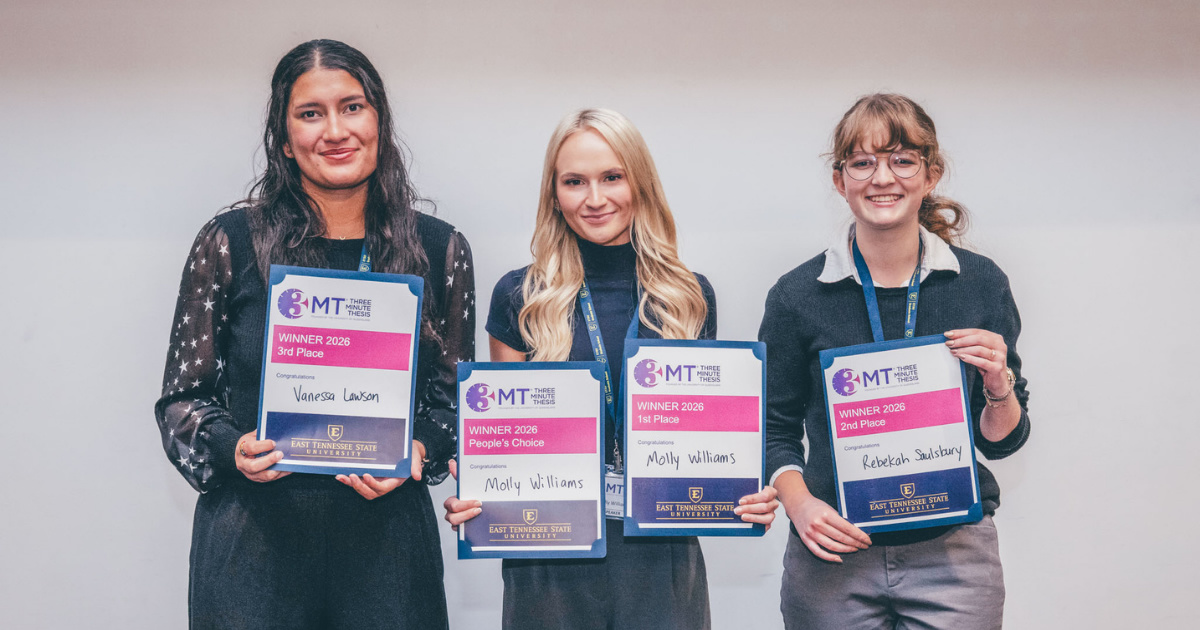
Molly Williams earns top honors in ETSU’s 2026 Three Minute Thesis 3MT® competition for research exploring new ways to reduce the survival of a potentially dangerous hospital pathogen.
A hospital bed rail, a countertop or even a door handle may seem like an unlikely place for dangerous bacteria to linger. But Acinetobacter baumannii, a bacterial pathogen, can survive on dry surfaces for extended periods, creating a persistent challenge in healthcare environments.
It's a problem that East Tennessee State University graduate student Molly Williams hopes her research can help address.
Why is Acinetobacter baumannii so hard to eliminate?
A. baumannii can cause serious infections, particularly among hospitalized patients and people with weakened immune systems. Many strains are resistant to multiple antibiotics, making infections difficult to treat. Its ability to persist on frequently touched surfaces also creates opportunities for transmission in healthcare settings.
Williams is investigating whether certain nutrient-based compounds can interfere with the bacterium's ability to survive without moisture, a process known as desiccation tolerance.
“Rather than focusing on traditional disinfectants, I am investigating whether nutrient-based compounds can reduce the bacterium’s ability to survive desiccation,” Williams said. “We are also interested in understanding how these compounds affect the bacteria, including whether they interfere with the cellular processes that help the bacteria survive under these conditions.”
Could nutrients help stop bacterial survival?
The approach may seem counterintuitive. Nutrients are typically associated with helping bacteria grow, but Williams is exploring whether certain compounds could actually make it more difficult for the pathogen to survive.
Ultimately, the research could help inform better strategies for reducing bacterial survival on surfaces commonly found in healthcare environments, while exploring potentially less toxic alternatives to traditional disinfectants.
What is ETSU’s Three Minute Thesis 3MT® competition?
For her presentation, “Cleaning the Surface: Targeting Acinetobacter baumannii with Nutrient Compounds,” Williams earned first place and the People's Choice Award in ETSU's annual Three Minute Thesis (3MT®) competition, an annual celebration of graduate scholarship that challenges students to distill complex research into compelling, accessible presentations.
For Williams, earning both competition awards was especially meaningful because one of her primary goals was to make her research understandable to people outside her field.
“I am incredibly grateful to have received both awards, considering how many talented graduate students participated in the competition,” she said. “Knowing that my presentation resonated with both the judges and the audience was incredibly rewarding.”
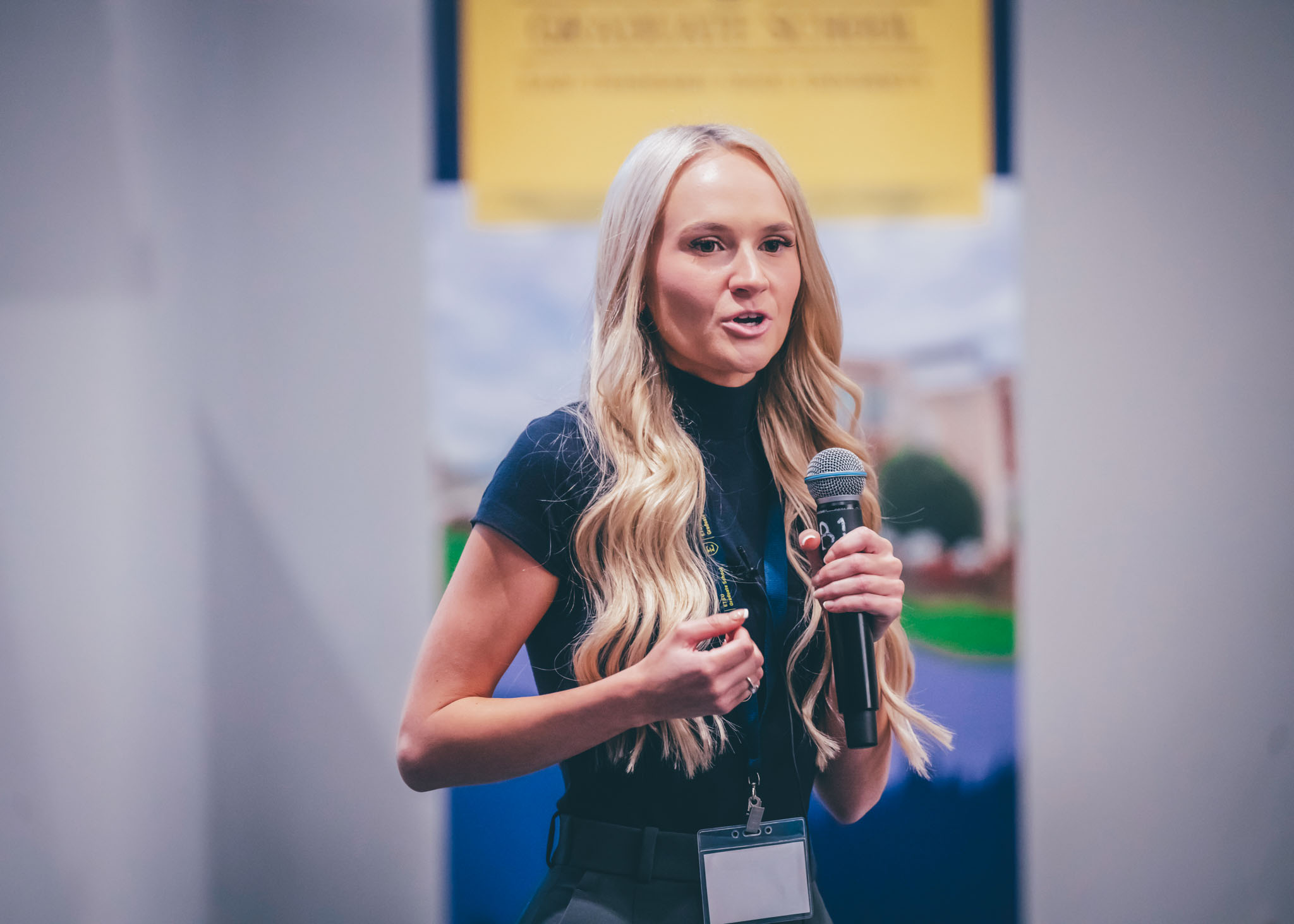
The 3MT ® competition challenges graduate students to explain their research in just three minutes, using a single slide and language accessible to a general audience. The competition helps students strengthen their research communication and presentation skills while introducing the public to the work happening in graduate programs.
“Distilling months, or years, of scholarly work into a clear, engaging and accessible presentation is a critical skill for graduate students to practice,” said Dr. Sharon James McGee, dean of the Graduate School.
The competition also highlighted research spanning a variety of disciplines. Rebekah Saulsbury earned second place for exploring the relationship between storytelling and sustainability in her presentation, “Happily Ever After? Wendell Berry's ‘The Stackpole Legend’ and the Power of Sustainable Endings.” Vanessa Lawson earned third place for her presentation, “Pregnancy and Birth Stress in Intergenerational Transmission of Adversity,” examining how pregnancy, birth stress and family support relate to intergenerational adversity as a result of the COVID-19 pandemic.
How does graduate research make a difference?
McGee said the competition also highlights the depth and innovation of research taking place at ETSU, where graduate students are tackling complex questions and developing solutions with the potential to make a difference in the region and beyond.
For Williams, her path to graduate research began at ETSU as an undergraduate. During her junior year, Dr. Erik Petersen welcomed her into his research lab, where she discovered a passion for asking scientific questions, designing experiments and working toward answers.
That experience helped inspire her decision to continue her education at ETSU.
“I truly believe my experiences here have helped shape the person I am today,” Williams said. “One of the things I appreciate most about ETSU is the faculty who genuinely want to see their students succeed.”
Williams will have the opportunity to represent ETSU at the regional competition.
From hands-on learning and research opportunities to advanced degrees, ETSU offers opportunities to take your education further. Explore the possibilities at etsu.edu/gradschool.