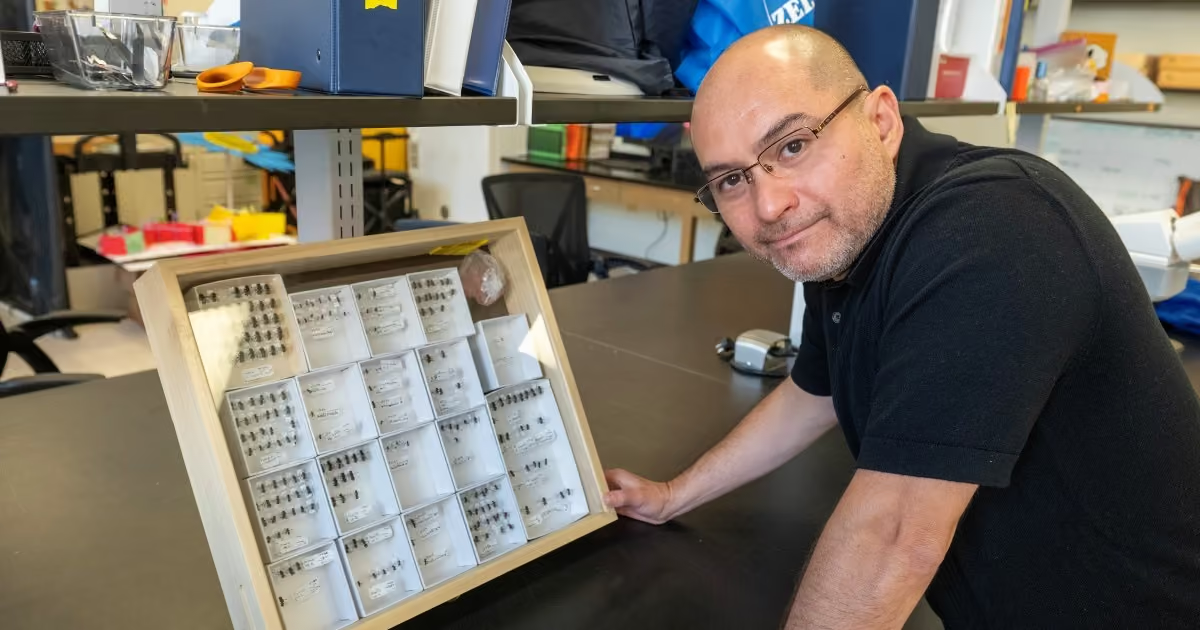
Dr. Gerardo Arceo-Gómez, an associate professor in East Tennessee State University’s College of Arts and Sciences, earned the university’s 2026 Distinguished Faculty Award in Research.
Arceo-Gómez, who joined ETSU in 2016, has published more than 65 peer-reviewed articles and focuses on plant-pollinator interactions, examining how relationships among flowers and the insects that pollinate them influence biodiversity, ecosystem health and food production. By studying these intricate ecological plant-pollinator networks, his work is helping scientists better understand how ecosystems function and how they may respond to environmental change.
“What distinguishes (Arceo-Gómez) is not simply the quantity of publications, but their conceptual depth and originality,” wrote one of his nominators.
“(Arceo-Gómez’s) research is widely regarded as innovative and field-shaping,” wrote another nominator.
Arceo-Gómez’s interest in plant-pollinator interactions began with mentors who introduced him to the remarkable complexity hidden within even the most fundamental interactions in nature.
"They first instilled in me this excitement for discovery and for generating new knowledge," he said. "Then they really showed me the beauty and the fine details of the interactions between plants and pollinators."
Those interactions, he explained, depend on countless factors, from the color, shape and scent of a flower to the ability of pollinators to navigate an environment rich in sensory information.
While the research explores fundamental ecological questions, its implications extend far beyond the laboratory.
Approximately 80% of the world's food crops depend on pollinators, making healthy pollinator populations essential to agriculture and global food security. As insect populations continue to decline worldwide, understanding how these ecological relationships function has become increasingly important.
"The pollination process is very important for our society," Arceo-Gómez said. "Trying to understand and minimize the impacts of disturbances on this key ecosystem service has become a very important component of this research field."
Arceo-Gómez said East Tennessee offered the ideal environment to pursue that work.
“When I first visited ETSU, what really impressed me was the people,” he said. “I was really impressed by the department's commitment to their students, their commitment to their community and really their commitment to collective success as much as individual success.”
He also found something equally important to an ecologist: Appalachia itself.
"As a biologist, you really can't ask for much more," Arceo-Gómez said. "You are in the middle of the Appalachian Mountains, one of the most biodiverse regions in the country and in the world.”
As someone who benefited firsthand from caring mentors, Arceo-Gómez is committed to supporting the next generation of student researchers. Since his arrival at ETSU, he’s trained and mentored more than 40 undergraduate, graduate and postdoctoral students.
“Without a doubt, I think the most rewarding part has been the mentoring aspect,” he said. “The opportunity to mentor young students and see them grow, develop and succeed in their professional and academic careers – that is probably one of the hardest, but without a doubt, one of the most rewarding aspects of this job."
For Arceo-Gómez, receiving the Distinguished Faculty Award in Research reflects not only his work but also the collaborative environment that first drew him to ETSU.
“I'm very thankful and grateful for this award and for the support I have received from the department and from this institution here at ETSU,” Arceo-Gómez said. “This award is a great recognition for the work that we have done, not just for me, but perhaps more importantly for the students and everyone who has contributed over the past 10 years.”
Watch the video above to hear more from Dr. Gerardo Arceo-Gómez on his work and what the Distinguished Faculty Award means to him.

.jpg)