
ETSU students and faculty collaborated across biology and engineering to design and build custom entomology pinning boards, turning a supply-chain challenge into hands-on learning.
Enrollment in East Tennessee State University’s General Entomology course has doubled over the past three years, creating a challenge that couldn’t be solved by simply ordering more supplies.
The foundational skill of pinning insects requires specialized pinning boards. However, after COVID-19 disrupted supply chains, entomology lost its major supplier. The available alternatives cost $20 to $50 per board and arrived with a frustrating flaw: the wood chipped and splintered. The boards were unusable.
Dr. Melissa Whitaker, assistant professor in the Department of Biological Sciences, faced a choice. She could keep ordering expensive, low-quality boards. Or she could try something different.
She chose differently.
Building a better solution
Brent McNutt, an undergraduate researcher in Whitaker’s lab, partnered with Bill Hemphill, associate professor, and David Zollinger, senior lecturer, both in ETSU’s Department of Engineering, Engineering Technology, Interior Architecture and Surveying, to design and build custom pinning boards for the class.
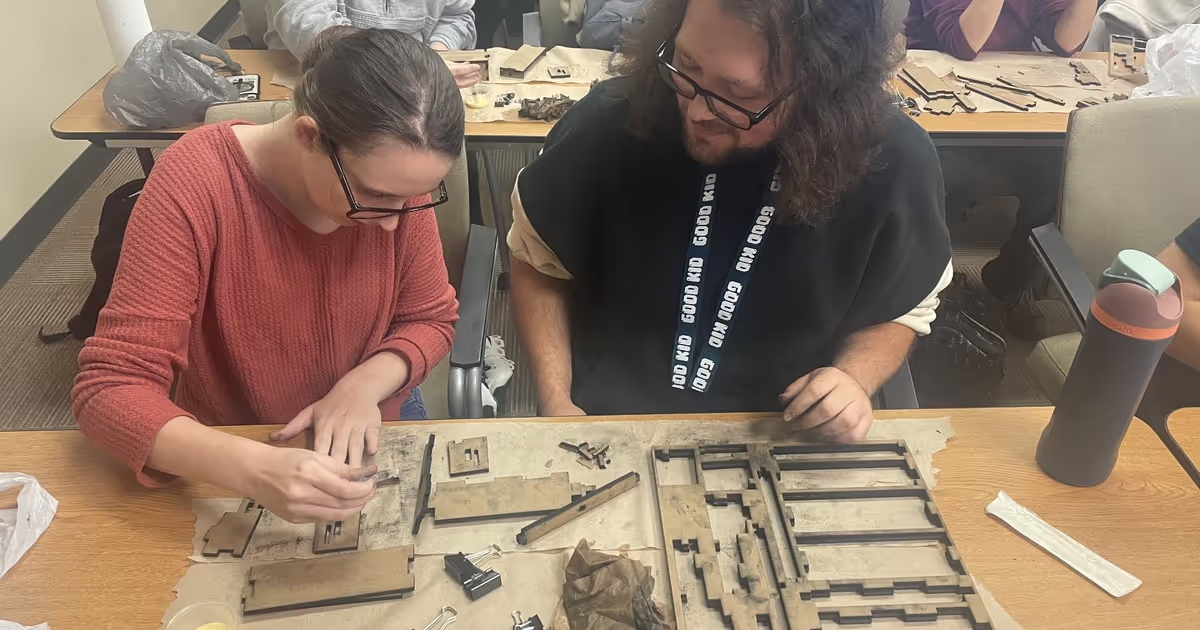
The team created custom build kits from laser-cut components that students could assemble during class.
The customization involved making the boards smaller – sized for two to three insects rather than the unwieldy full-size boards available commercially – and adding the ETSU logo to every in-house-built board.
The result: students didn’t just receive their tools. They built them.
Creators, not consumers
The activity reflects a broader teaching philosophy Whitaker is implementing across her curriculum, inspired by the Makers Movement.
“Our biology students spend most of their academic and non-academic lives in front of screens, passively consuming content,” Whitaker said. “They have remarkably few opportunities to work with their hands to build something tangible, despite hands-on creation being one of the most powerful ways to learn.”
The pinning board activity positioned students as creators. It also connected them to a long tradition in entomology, where researchers have historically made their own equipment out of necessity.
Collaboration across disciplines
The project exemplifies collaboration within ETSU’s School of Science, Engineering and Math, where faculty and students from different disciplines work together to solve real-world problems.
Hemphill and Zollinger brought technical expertise in design and fabrication, and a strong commitment to training and mentoring students. Biology students gained hands-on experience creating the tools they would use in their scientific work.
Everyone benefited from seeing how their field connects to others.
Whitaker is weaving maker activities throughout her curriculum. In her entomology class, students also participate in a tie-dye activity in which they create products from 100% insect-derived materials such as silk and cochineal. In the future, she hopes to connect with makers from ETSU’s Department of Art and Design in an effort to fuse biology, art and engineering.
“This project is a great example of how hands-on learning and collaboration across disciplines prepare our students to think creatively and solve real problems,” said Dr. Joe Bidwell, dean of ETSU’s College of Arts and Sciences. “When faculty empower students to build, design and experiment, learning becomes deeper and more lasting.”
Explore the many ways ETSU faculty and staff utilize hands-on learning at etsu.edu/go-beyond.
.jpg)